Eye Tracking
Eye tracking problems can make reading, copying, sports, and everyday visual tasks more difficult. Eye tracking describes the skills our eyes use to explore the environment, follow moving objects, and move accurately across a line of print.
Children with eye tracking problems may lose their place, skip words, transpose words, or use a finger to follow each line. These difficulties can make reading feel slow and tiring, and they may also affect comprehension.
Our eyes should move automatically using the following tracking skills:
• Hold our eyes still so we can see an object and take in information about it (fixation)
• Quickly and accurately jump from one object to another (saccades)
• Track and follow a moving object (pursuits)
When we read, our eyes don’t move smoothly across the line. Instead, our eyes make a series of jumps and pauses as we read. The small jumps between words or groups of words are called saccades. The brief pause we make while looking at the words is called a fixation. After a fixation, we move our eyes to the next word or group of words—another saccade.
This very precise coordination of jumps and pauses is controlled by our central and peripheral visual systems. Our central vision processes what we’re seeing in clear detail and defines what we’re looking at. Our peripheral, or side vision, simultaneously locates surrounding objects and let’s us know where to look. (These two systems are sometimes referred to as the “Where is it?” and “What is it?” systems.) In reading, our central vision processes the word, while our side vision locates the following word and tells us where to aim our eyes next. The integration of these two systems is what allows us to efficiently move our eyes along a line of print without overshooting or undershooting, or mistakenly aiming our eyes at lines above or below. If there is not continuous, fluid, simultaneous integration between these two systems, reading will be jerky, loss of place will be common, and comprehension will be poor.
As you read this sentence, your eyes stop on a word as you take in the information, then jump to the next word and stop again. This automatic skill gives us speed and control of where our eyes are aiming, and is essential for efficient reading, writing, copying from the board, playing sports and many other activities.
Development of eye tracking:
The infant reflexively turns the entire upper torso toward the direction of a noise, and then gradually learns to turn only the head to guide the visual system. Through the toddler years the individual refines this movement system by learning to use eye muscles to replace head movement – an achievement important in visual readiness for school. By 6 – 6.5 years of age, a child should be able to follow a target with eyes only (not following with head or nose) without being specifically instructed to do so. (This is one sign of visual reading readiness). Eventually vision becomes the dominant sense. But this cannot occur without the adequate interactions between vision and motor! If a child has delays with motor development and coordination, it is possible that delays in vision and fine motor control will result as well.
If the Eye Tracking system is not functioning efficiently, it can create many symptoms:
• Poor reading comprehension
• Loss of place when reading, writing or copying
• Use of a finger or marker when reading
• Difficulty copying from the board
• Skipping or repeating words
• Difficulty maintaining attention
• Reversing words or letters
• Head movement side to side while reading
• Poor handwriting
• Poor performance in sports
• Read erratically from right to left and left to right?
• See words move or jiggle on the page while reading?
• Need to use your finger when reading text to keep your place?
• Need to put a bookmark below the line that you are reading to keep your place?
• Can seem to keep their place when reading books with large print and little quantity of print but frequently loses their place when reading books with much more and smaller text
• Move your head when reading instead of your eyes?
Want to experience the amount of effort required to read for the person with a oculomotor eye tracking dysfunction?
Try Calgary Vision Therapy’s Tracking Dysfunction demo
Children with tracking problems can’t control their eye movements at close ranges. The following is an example of how their eyes move during reading, especially as they fatigue:
Connection between Eye Tracking and Motor Coordination:
Eye Tracking can be thought of as a super-fine motor coordination skill. If overall motor coordination skills are not well developed, it is likely that fine motor (handwriting) and eye tracking skills will be poor as well. When writing, the eyes have to lead the hands. If the eyes don’t move accurately and reliably, handwriting may become slow, messy and inconsistent. One approach to training the eye tracking system includes training the overall motor coordination system
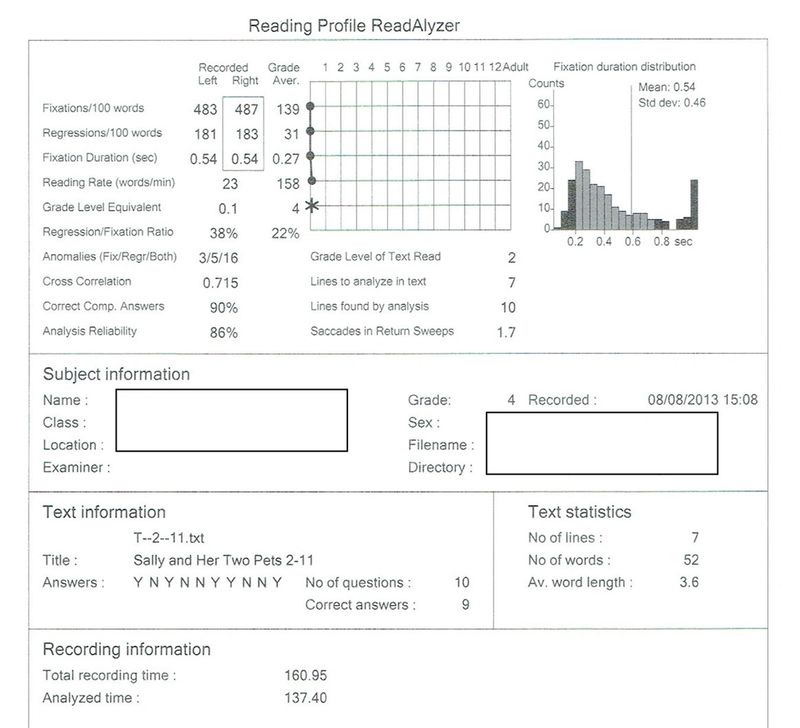
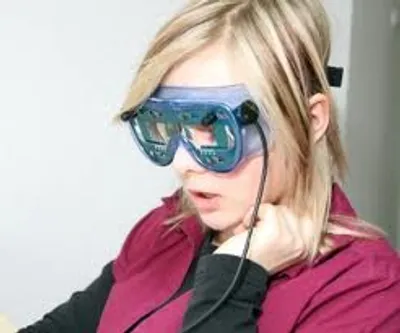
Testing eye tracking with readalyzer
Additional Information
For more background on learning-related vision problems, you can review the American Optometric Association’s guideline on learning-related vision problems.
Readalyzer simulation
Watch the video of an actual ReadAlyzer result simulation. This test was done on a grade 4 female who has been struggling with reading. The moving shaded box over the words show where her eyes were pointing when she was reading.
Her ReadAlyzer Reading Profile reveals that her mechanical movements of the reading process is operating at a grade 0.1 equivalency. She is making 3.5 times more fixations (stops on words/segments of words) and almost 6 times more regressions (going back over words/segment of words/backtracking on the same or different line) than we would expect for a grade 4 student.
Although she is 20/20, her deficiencies in her vision (visual system) is contributing a significant roadblock in her ability to read.
Want to experience the amount of effort required to read for the person with a oculomotor eye tracking dysfunction?
Visit the Eye Tracking Demo Page