What Is
Convergence Insufficiency?
Convergence insufficiency is a treatable binocular vision disorder that affects the ability to maintain clear and single images within arms reach like when you are reading a book. Vision therapy can help train the eye teaming skills used for reading and close work. For a general medical overview, see the National Eye Institute’s convergence insufficiency resource.
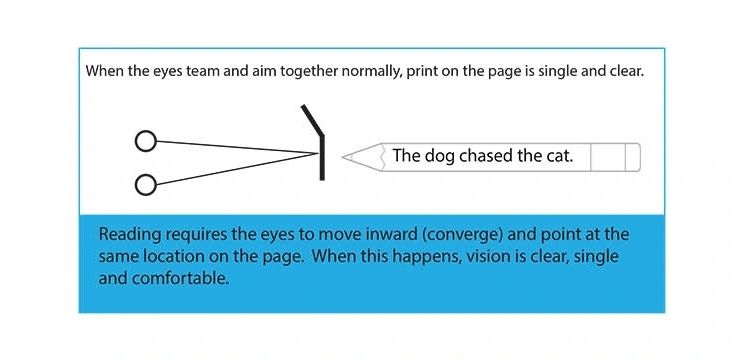
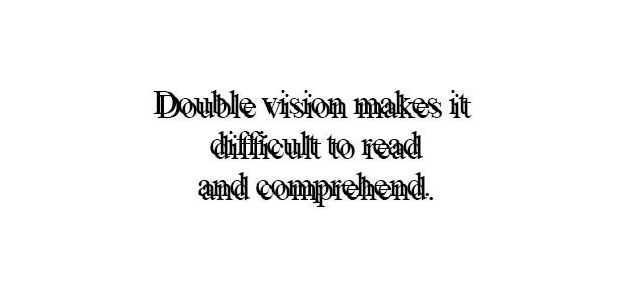
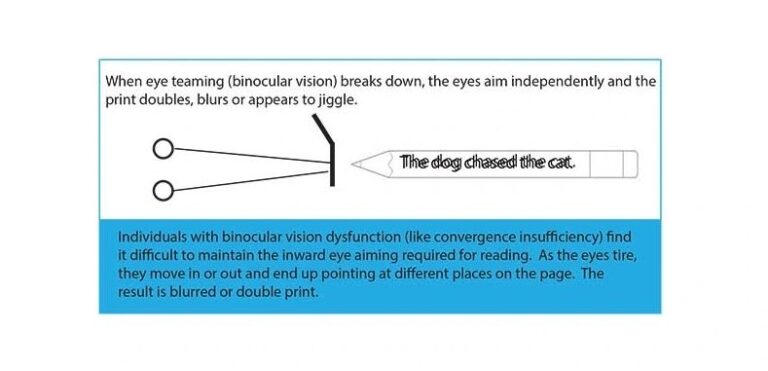
When we look at a book, our eyes point inwards together (converge) and both eyes are to point and focus at the same place in space. When this does not happen, individuals can experience diplopia (double vision) or overlapping of pictures/text or movement of print when focusing on a close object, such as a book, computer, tablet, smartphone, etc.
CI And Attention Deficit Disorder
Undiagnosed Convergence Insufficiency is often mistaken by individuals, teachers, friends and family as “laziness”, “clumsiness”, “day dreaming” or even Attention Deficit Disorder or Attention Deficit Hyperactive Disorder.
"Consider if you are seeing doubling when reading, how long will you persist with your reading or desk tasks? Not very long. In a classroom setting, what is there to do? Often it would be talking to the classmate beside you or getting up and sharpening the pencil again or yet another bathroom break."
A 2005 study published in Strabismus 13:164-168, 2005 reported an apparent three time greater incidence of ADHD among patients with CI when compared with the incidence of ADHD in the general US population.
What is Convergence Insufficiency?
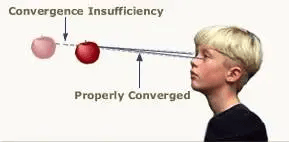
What Is Convergence Insufficiency?
Convergence insufficiency means.....
Convergence insufficiency means the eyes struggle to focus easily for near tasks, affecting school work attention and office performance in adults.
For people with normal healthy convergence.....
Convergence Insufficiency in Children and Learning
It is possible that four children in every classroom.....
Convergence Insufficiency can affect both children and adults. In fact, several children in one classroom may struggle with this condition. It does not always go away on its own.
Because this condition affects near vision, it can make reading harder. As a result, parents or teachers may suspect a learning disability or dyslexia instead of a vision problem.
However, a vision evaluation can help identify the cause. Early diagnosis and treatment can support reading, learning, sports performance, and daily visual tasks.
Vision Problems and ADHD-Like Symptoms
Some children with learning difficulties show impulsivity, hyperactivity, and distractibility. Many people associate these behaviours with Attention Deficit Hyperactivity Disorder (ADHD).
However, undetected vision problems can create similar signs. Therefore, some children with vision problems may be mislabelled as having ADHD.
Symptoms of Convergence Insufficiency
Convergence Insufficiency can come with many different symptoms, and some of those symptoms present in the same way as reading difficulties, such as dyslexia. But, while dyslexia is a language disorder, Convergence Insufficiency is a visual disorder.
Symptoms of Convergence Insufficiency may include:

CI And The Standard 20/20 Eye Test
A 20/20 result on a vision chart simply means you can see a certain size letter at a certain distance. It does not measure how efficiently your eyes work together up close.
For comfortable reading, both eyes must move, focus and aim as a smooth, coordinated team. This process is called eye teaming, and the more technical term is binocular vision.
Convergence Insufficiency is a binocular vision impairment that can affect learning, reading, sports performance and many everyday activities, even when distance eyesight is “perfect”.
What Is The Best Treatment For CI?
Office-based Optometric Vision Therapy is the most effective treatment for Convergence Insufficiency. Weekly office visits are combined with a customized home program to build and reinforce more efficient visual skills.
On average, patients can expect several months of structured therapy to restore comfortable, coordinated near vision.
Individualized treatment sessions designed to rehabilitate the connection between the eyes and the brain, improving teaming, focusing and tracking skills.
Special lenses that can reduce some symptoms by shifting where the eyes need to aim. They are sometimes used together with, or as an alternative to, office-based vision therapy.