
Visual Learning Skills
Eye Tracking Dysfunction
Eye tracking dysfunction can make reading, learning, and everyday visual tasks harder because the eyes may not move accurately together
What is Eye Tracking?
Eye Tracking describes the visual skills we use every day to explore our environment, play sports, and most importantly – to read.
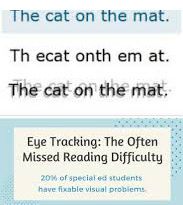
Children with tracking problems have not learned to control the fine eye movements required to follow a line of print. They often lose their place, skip words, or transpose letters while reading.
Eye tracking skills also connect closely with Vision & Learning because they support reading, attention, and classroom tasks. For a professional overview of learning-related vision problems, review the American Optometric Association guideline.
Many children must use their finger to follow the line of text because their eyes cannot accurately guide the reading process.
Key Eye Tracking Skills
How Our Eyes Move While Reading
When we read, our eyes do not move smoothly across the line of text. Instead they move in a sequence of jumps and pauses.
The small jumps between words are called saccades, while the brief pause when the eyes focus on a word is called a fixation.
This precise coordination allows us to process information quickly and efficiently when reading.
Central vs Peripheral Vision
Our visual system is controlled by two important components. Central vision processes detailed information and identifies what we are looking at.
Peripheral vision helps locate surrounding objects and guides our eyes toward the next word or object.
Why Integration Matters
Efficient reading depends on the smooth coordination between central and peripheral vision. If these systems do not work together properly, reading becomes slow and jerky.
Development of Eye Tracking
During infancy, children move their entire body toward visual stimuli. As they grow, they gradually learn to guide their visual system using only their eyes.
By around age 6 to 6.5, a child should be able to follow a moving object using only their eyes without moving their head.
Vision development is closely connected with motor coordination. Delays in motor development may also impact eye tracking and visual control.
Symptoms of Eye Tracking Problems
Eye Tracking & Motor Coordination
Eye tracking is a highly refined motor coordination skill.
If overall motor coordination is weak, handwriting and eye tracking skills may also be affected.
When writing, the eyes must guide the hands. If the eyes cannot move accurately, handwriting may become slow and inconsistent.
Testing Eye Tracking with ReadAlyzer
The ReadAlyzer is a computerized eye movement recording system that measures how effectively the eyes work together while reading.
It uses infrared sensors inside special goggles to analyze reading performance and eye movement patterns.
Reading Analysis
The majority of the time, the child will get their eyes checked and be told that they have 20/20 vision and that everything is fine. However their visual skills may not be working properly for reading and learning.