
ADHD & Vision
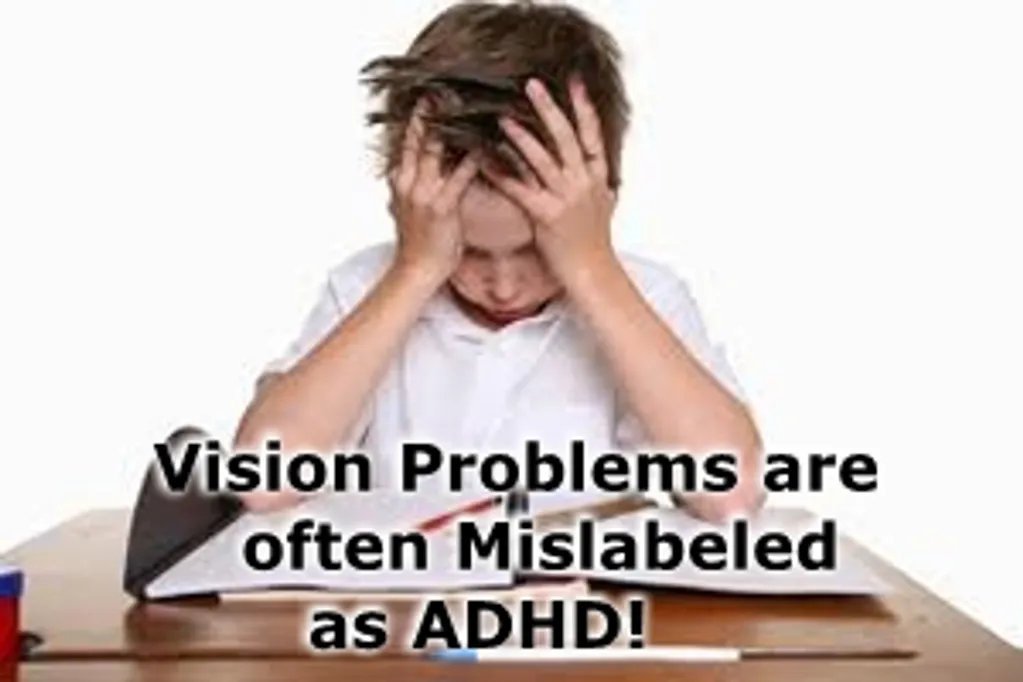
Some children with learning difficulties exhibit specific behaviors of impulsivity, hyperactivity, and distractibility. A common term used to describe children who exhibit such behaviors is Attention Deficit Hyperactivity Disorder (ADHD). Undetected and untreated vision problems can elicit some of the very same signs and symptoms that are commonly attributed to ADHD. Due to these similarities, some children with vision problems are mislabeled as having ADHD.
The Striking Differences Between ADHD And Functional Vision Problems
At school, children with ADHD may struggle to focus. They may also fidget, squirm, appear careless, or miss instructions. However, functional vision problems can create similar symptoms. Therefore, a careful vision evaluation can help families understand whether visual skills are affecting learning.
Research on Vision and Attention
A recent study by researchers at a children’s eye center uncovered a relationship between a common vision disorder, convergence insufficiency, and ADHD. For general information about ADHD symptoms, visit the CDC’s ADHD symptoms resource.
“Children with convergence insufficiency are more likely to be diagnosed with ADHD than children without the disorder… Patients diagnosed with ADHD should also be evaluated for convergence insufficiency and treated accordingly.”
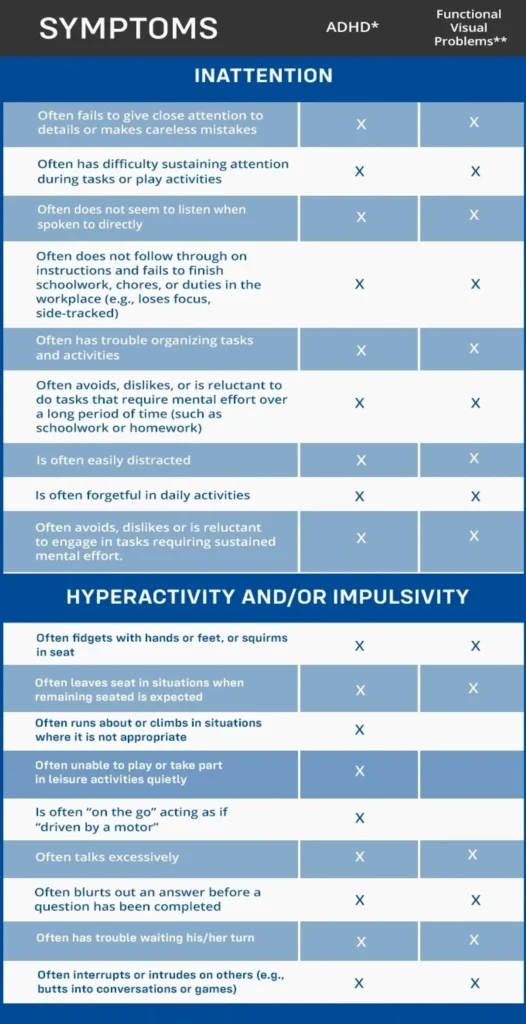
The Striking Differences Between ADHD And Functional Vision Problems
In school, children with ADHD often have difficulty focusing. They may also fidget or squirm in their seat, appear careless in their work, and/or fail to follow through on instructions. Does this sound familiar? As you learned above, functional vision problems in children can produce a similar set of symptoms.
Why Vision Problems Can Be Misread as Attention Problems
ADHD is common in children. As a result, a doctor may consider ADHD when a child shows attention, behaviour, or learning concerns. However, several vision problems can cause similar symptoms. In some cases, a child may receive ADHD treatment while an underlying vision problem remains hidden. For this reason, a complete vision evaluation can help families understand whether ADHD, a vision problem, or both may play a role. If you suspect ADHD, also consider testing your child for functional vision problems.
Common Overlapping Symptoms:
Struggles to pay attention
Tests poorly, even when they know the material
Starts assignments but has trouble completing them
Has trouble organizing tasks
Difficulty with reading or writing
Makes careless mistakes
Poor performance in sports
This can result in a child being prescribed medication as a cure, when what they really need is vision correction. If a child has any of the following symptoms, it could be due to ADHD or a vision problem (or both), which is why a correct diagnosis can be tricky.
Due to the similarities in symptoms, if your child is suspected of having ADHD, it is wise to also get them tested for a vision disorder.
Vision Disorders That Can Mimic ADHD Symptoms
When a child has problems with their functional vision, certain visual skills become lacking, which results in symptoms like those of ADHD.
Functional vision is how your complete visual system, including your eyes, brain and the visual pathways between them, work together to make sense of the world around you.
Problems with functional vision means the eyes and brain do not work together properly and can result in difficulty with focusing, depth perception, tracking skills, reading comprehension, hand-eye coordination and more.
Therefore, getting your child evaluated for functional vision disorders can help you determine the best course of treatment.