
The Connection Between
Learning Difficulties and Vision
Considering 80% of the information students process comes through the visual system, vision can affect many school skills.
For example, a vision problem may make reading, writing, spelling or math feel harder.
At the start of the day, a student may read clearly. However, double vision can appear or get worse later.
Some people close or block one eye to avoid seeing double. As the visual system gets tired, reading may become more difficult.
How Vision Supports Learning
Clear and comfortable vision helps children read, write and learn with less effort. However, some vision problems can make schoolwork feel harder.
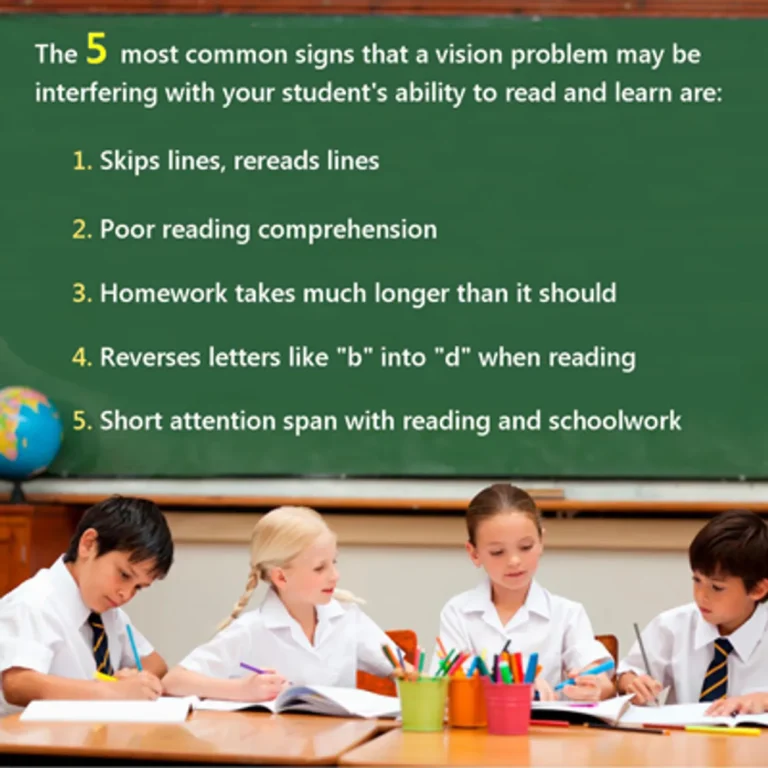
How Vision Affects Learning
Vision problems can affect learning in several ways. Below are the main areas where students may struggle.
Reading
Reading and reading comprehension are different skills. However, both depend on clear and comfortable vision.
Learning to Read
Early learning to Read
In early reading, clear vision helps students recognize letters and numbers.
However, a serious vision problem can make this harder. It may also affect memory for letters, numbers and word patterns.
Reading to Learn
Reading to Learns
As schoolwork becomes harder, students must read for longer periods.
However, blurry or double vision can make reading tiring. As a result, the student may avoid reading or understand less of the text.
Reading Comprehension
How Vision Affects Comprehension
The visual system supports reading comprehension. If words look blurry or double, the child must work harder to keep them clear.
Therefore, less energy remains for understanding the message.
Decoding and Fluency
Why Decoding Can Feel Slow
Students with vision problems may spend too much effort decoding words.
Instead of reading smoothly, they may focus on each word. As a result, reading can feel slow and tiring.
Eye Tracking Signs
Signs of Poor Eye Tracking
Poor eye tracking can make students use a finger to follow text. They may read slowly and lose their place.
In addition, they may repeat, skip, insert or change words. These signs may look like poor attention, but vision can be part of the problem.
Before reading can feel smooth, the eyes need accurate movement. Otherwise, reading may become slow and choppy. In addition, comprehension can drop because the student uses too much energy to move the eyes. Optometric vision therapy can help improve these visual skills. Then the child may feel more ready to learn.
Read more about eye tracking dysfunctions and how they impact a child’s ability to learn and to read.
Math
An important skill in math is to organize what is being written and the student may have trouble lining things up
Seeing Signs and Decimals
How Clear Vision Supports Math
If a student has difficulty seeing things as clear and single, they may have trouble seeing decimals and/or signs. An important skill in math is to organize what is being written and the student may have trouble lining things up and keeping their place if their visual skills are poor. This could be due to poor eye tracking or binocularity instability.
Laterality and Directionality
Understanding Left, Right and Direction
Laterality and directionality (concrete understanding of left and right and the ability to project those out into space) are also important concepts in math. If a student sees the orientation of numbers incorrectly, they will have difficulty completing the problem.
Visualization and Timed Tests
How Visualization Helps With Numbers
Students who lack visualization skills can often be found counting on their fingers or verbalizing sequences. Given enough time, they can generally compute an answer, but they tend to do poorly on timed tests. Awareness of numbers and what they mean as well as being able to visualize numbers and quantities, are critical to success in math and can be impacted if a child has a vision problem.
Math May Look Stronger Than Reading
Why Math Can Seem Easier
It should be noted that a child with vision problems may do well in math but be a poor reader, primarily because math doesn’t require as many precise eye movements as reading.
Spelling
Visual Recall and Spelling
Visual Recall and Spelling ability
Visual recall, the ability to create a visual image based on past visual experience without currently having that experience, is a visualization skill that is critical for spelling. In spelling, it is the ability to create a mental image of a word without being able to look at the word.
Writing
Writing involves both handwriting and composition skills.
Handwriting and Visual Guidance
How Vision Guides Handwriting
Writing involves both handwriting and composition skills. It is necessary for vision to lead the hand for handwriting and this can be very difficult if the student cannot see well. In fact, often you can see in the handwriting where the student stopped looking or became fatigued. Difficulty writing straight on a page is often a result of poor peripheral awareness.
Vision Skills for Handwriting
Key Visual Skills for Handwriting
There are several vision-related skills that are critical to good handwriting that may be underdeveloped in a student with vision problems. Visualization is also important in handwriting because the student needs to remember what different words look like in order to reproduce them on the page. Spatial concepts are important in handwriting to know and plan how words will go together. Good laterality and directionality are important to differentiate similarly shaped letters in different orientations (e.g. b, d, p, q).
Writing Composition
Organizing Ideas Before Writing
Visualization is also critical for writing composition because the student needs to be able to organize and re-organize the composition in his or her head.
See the College of Optometrists in Vision Development (COVD) resource on vision conditions. You can also download the related facts and figures PDF below.